

Exhibition of Work by Lester Leroy Amen Opening in the Side Gallery
Lester Leroy Amen (1954–2014) A Love of Drawing and Intelligent Experimentation Lester Leroy Amen was born on 18 April 1954 in Omaha, Nebraska, and passed away on 22 May 2014 in Florida. Over the course of sixty laps around the Sun, Les lived a life defined by relentless creativity, inner turbulence, and an unwavering need to make sense of the world through art. From an early age, drawing was not simply a skill but a way of thinking. Raised in Council Bluffs, Iowa, alongside his brothers Tom and Marty, Les…
- This event has passed.
Lester Leroy Amen (1954–2014)
A Love of Drawing and Intelligent Experimentation
Lester Leroy Amen was born on 18 April 1954 in Omaha, Nebraska, and passed away on 22 May 2014 in Florida. Over the course of sixty laps around the Sun, Les lived a life defined by relentless creativity, inner turbulence, and an unwavering need to make sense of the world through art.
From an early age, drawing was not simply a skill but a way of thinking. Raised in Council Bluffs, Iowa, alongside his brothers Tom and Marty, Les showed uncommon visual sensitivity as a child. His talent was formally recognized in junior high school when he received an American Legion art award in 1970—an early affirmation of a lifelong relationship with line, form, and experimentation.
In 1971, the Amen family relocated to Lancaster, Texas, where Les graduated from high school in 1973. Shortly after, he left home and hitchhiked across the country, entering a pivotal period marked by exploration, instability, and intensity. These years—restless and unresolved—eventually prompted him to enlist in the United States Marine Corps, an inflection point that brought structure and discipline to both his life and his art.
While serving in the Marine Corps, including time stationed at Quantico and in the Philippines, Les’s artistic abilities were formally recognized. He was encouraged to document Marine Corps activities visually and to work continuously from life, carrying sketchbooks and painting directly in the field. His dedication and rapid improvement led to the accession of eleven of his works into the U.S. Marine Corps Museum Art Collection. Five of these were selected for the “Every Clime and Place…” exhibition—an uncommon achievement for a first-time exhibitor—and one received an award in the annual Combat Correspondents contest.
In a February 1985 letter, the Curator of Art for the Marine Corps wrote that Amen possessed “an open mind, a love of drawing and intelligent experimentation, a capacity for hard work, and a strong sense of responsibility.” That phrase—a love of drawing and intelligent experimentation—would come to define Les’s life’s work quietly.
Following his honorable discharge in 1981, Les continued to pursue art seriously. He earned a Bachelor of Fine Arts from the Corcoran School of Art in Washington, D.C., in 1988. During this period, he also worked in sculpture; one notable piece—a figure depicting a man struggling while carrying a burden—was sold to a downtown Washington law firm, an extraordinary achievement for a student and a recurring thematic expression of Les’s inner world.
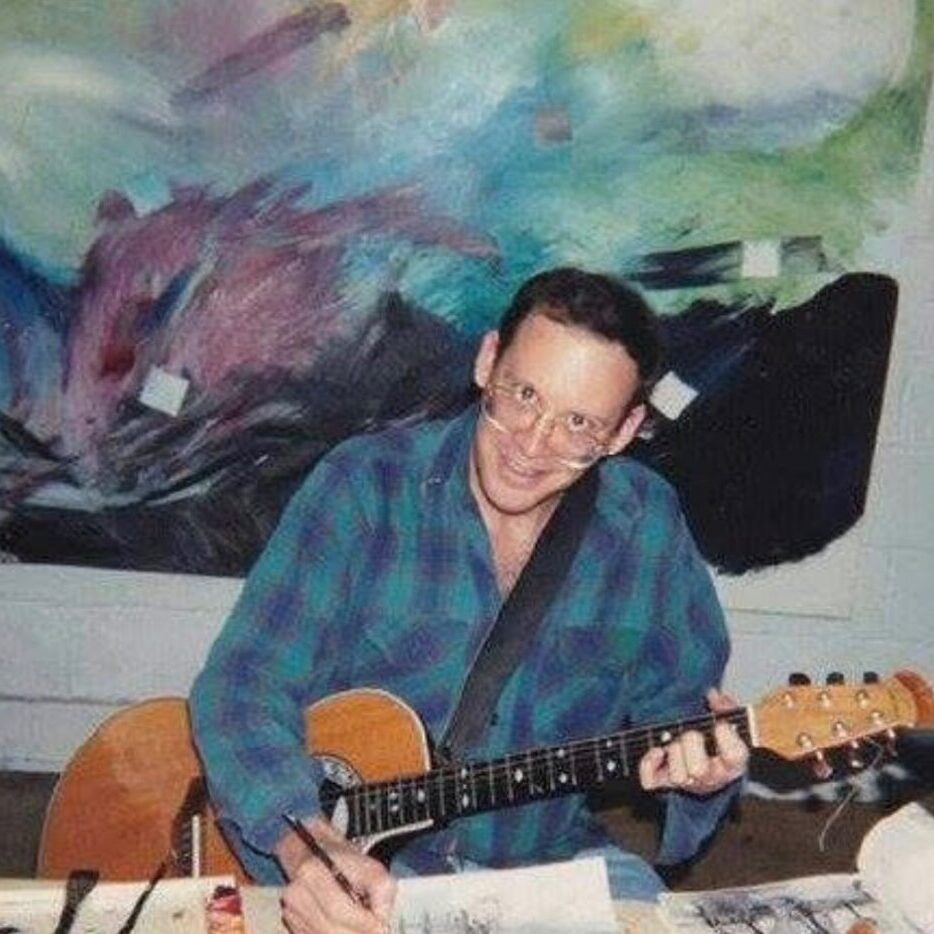
Les also expressed himself through music, playing guitar and performing in several bands. Whether through sound or image, improvisation and intensity were constant threads. Expression was never optional; it was essential. Despite formal training and moments of institutional recognition, Les’s life remained unsettled. He carried deep internal tension, and his path was often marked by conflict and restlessness. During a later chapter of his life, following his divorce, Les spent approximately one year incarcerated in Fairfax County Jail because of a personal dispute unrelated to his former spouse.
It is from this period that some of his most compelling and revealing works emerged.
Working with severely limited materials, Les created dense, intricate compositions on grocery bags and discarded paper—surfaces never intended for preservation. These works are not exercises in despair but acts of defiance. Every inch is activated. Space is filled, reworked, and layered, as if drawing itself were a means of survival. Language appears within the image. Symbols collide with figures. Order wrestles with chaos. Confinement becomes both subject and condition.
These pieces do not ask for sympathy. They ask for attention.
Though Les produced thousands of works over his lifetime, he rarely sold them. Art was given away, left behind, lost, or carried forward with him. What remains today—approximately one hundred preserved works—represents only a fragment of his output, but a powerful one. Together, they form a visual record of persistence: an artist who continued to draw regardless of recognition, circumstance, or outcome.
In his final years, Les was diagnosed with pancreatic cancer, a battle he faced for more than a year. He passed away in Florida in May 2014 and was reunited with his brothers near the end of his life.